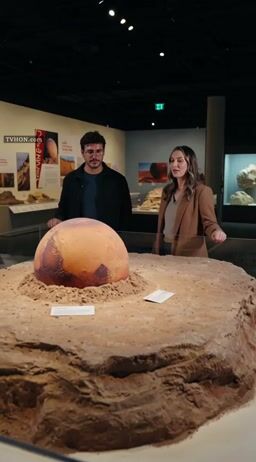
The Big Mystery: Why We Still Haven’t Found Life Beyond Earth
Scientists have not yet found any proof of life outside Earth.
Details
For many years, scientists have explored space looking for signs of life beyond our planet, but so far no clear evidence has been discovered. Research programs studying planets, moons, and distant star systems continue to scan for chemical signals or conditions that might support living organisms. While some worlds like Mars, icy moons, and faraway planets show hints of environments that could be suitable for life, none have produced confirmed biological proof. Space missions and advanced telescopes keep improving how we study the universe, allowing scientists to analyze atmospheres and surfaces of distant planets in greater detail. These efforts focus on finding patterns in gases or materials that might suggest biological activity, but every signal found so far has alternative explanations that do not require life. The absence of confirmed discoveries does not mean life is impossible elsewhere, only that it has not yet been observed or verified. The search continues across the solar system and beyond, driven by one of humanity’s most important questions about whether we are alone in the universe.
More videos
- How Mars Built a Giant Volcanic Region Without Plate Tectonics
Mars lacks plate tectonics, so volcanoes kept erupting in one region for billions of years, piling up lava until the crust was heavily stressed and fractured.
Tags: Astronomy
- The Star That Passed Closest to Our Solar System 70,000 Years Ago
About 70,000 years ago, Scholz's binary star system passed within 0.8 light-years of the Sun, likely crossing the outer Oort Cloud.
Tags: Astronomy
- Titan Has Air Thick Enough to Skip a Pressurized Spacesuit
Titan has surface pressure about 1.5 times Earths, so a human would not need a pressurized suit there, but would still need oxygen and extreme cold protection.
Tags: Astronomy
- Asteroid, Meteoroid, Meteor, Meteorite: What Is the Difference?
A space rock can be a meteoroid, meteor, or meteorite depending on where it is, while asteroids are larger rocky bodies orbiting the Sun.
Tags: Astronomy
- The Black Hole Image That Needed Half a Ton of Hard Drives
The first black hole image used about 5 petabytes of data, filling over half a ton of hard drives, and some of it was faster to fly than send online.
Tags: Astronomy
- Up to 85% of Stars May Belong to Multiple-Star Systems
Up to 85% of stars may belong to systems with two or more stars, making solitary stars like our Sun unusual by star count.
Tags: Astronomy
- Up to Half of Earth’s Water May Be Older Than the Sun
Up to half of Earth’s water may have formed in interstellar space before the Sun and survived the birth of our solar system.
Tags: Astronomy
- How Massive Stars Collapse Into Neutron Stars Only About 10 Kilometers Wide
Some massive stars swell into red giants, then explode and leave behind a neutron-star core only about 10 kilometers across.
Tags: Astronomy
- Betelgeuse Will Eventually Explode as a Supernova Bright Enough to See by Day
Betelgeuse, a red supergiant in Orion, will eventually explode as a supernova bright enough to see by day for months, but it will not harm Earth.
Tags: Astronomy
- Saturn Is the Solar System’s Only Planet Less Dense Than Water
Saturn is the only planet with an average density lower than water, so a gigantic enough water tank could theoretically let it float.
Tags: Astronomy
- Earth’s Moon Is Exceptionally Large Compared With Its Planet
Earth’s Moon is the Solar System’s largest and heaviest moon relative to its planet, measuring about 27% of Earth’s width and 1.2% of its mass. [oai_citation:0‡NASA Space Science Data Archive](https://nssdc.gsfc.nasa.gov/planetary/factsheet/moonfact.html?utm_source=chatgpt.com)
Tags: Astronomy
- If the Solar System Fit in Your Hand, the Milky Way Would Span North America
Shrink the Solar System to fit in your palm, and the Milky Way would stretch across North America, with hundreds of billions of stars inside it.
Tags: Astronomy