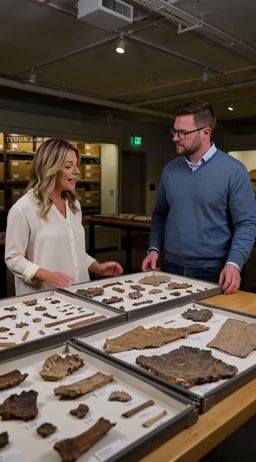
Most Life on Earth Left No Fossil Record
Only a tiny fraction of species that ever lived became fossils, and an even smaller share has been found, leaving most of lifes history unknown.
Details
The fossil record is only a small window into the history of life on Earth. Most organisms that die never become fossils because fossilization requires unusual conditions, often including rapid burial and protection from decay, scavengers, erosion, and later geological destruction. Organisms with hard parts and those living in environments where burial is more likely have better odds of leaving evidence behind. Even after a fossil forms, it can remain buried, be destroyed by geological processes, or simply never be discovered. Scientists therefore know that the fossil record is highly incomplete and biased toward organisms and environments that preserve well. Estimates vary depending on how species and fossils are counted, but published estimates indicate that far less than one percent of all species that ever lived left a fossil record. This means the fossils scientists study are an important but very incomplete sample of ancient biodiversity. New discoveries continue to add pieces to the story, while countless species and details about ancient life may never be recovered.
More videos
- Study Reported a Massive Shark Die-Off 19 Million Years Ago
A 2021 study reported that open-ocean sharks may have lost over 90% of their abundance about 19 million years ago, but the cause and scale remain debated.
Tags: Earth
- How Challenger Deep Was First Found in 1875
In 1875, a scientific ocean expedition found Challenger Deep while sounding the seafloor, revealing an unexpectedly deep part of the Pacific.
Tags: Earth
- Why More Than 80% of the Ocean Is Still Unmapped and Unexplored
More than 80% of the ocean remains unmapped, unobserved, and unexplored, leaving huge parts of Earth’s underwater world largely unknown.
Tags: Earth
- The Dinosaur-Killing Asteroid Hit an Exceptionally Unlucky Spot
The asteroid that ended the dinosaur era hit sulfur- and hydrocarbon-rich ground, helping fill the sky with soot and trigger global cooling and mass extinction.
Tags: Earth
- Coral Reefs Are Built From the Skeletons of Tiny Animals
Coral reefs are built by tiny coral animals called polyps, which make hard calcium-carbonate skeletons that accumulate into huge reef structures.
Tags: Earth
- How Trees Share Signals Through Forest Networks
Trees can exchange signals through fungal networks and airborne chemicals, warning nearby plants of danger and sometimes moving nutrients between connected trees.
Tags: Earth
- Fossil Fish Reveal the Season of the Dinosaur-Killing Asteroid Impact
Fossil fish caught in impact-driven water surges suggest the asteroid that ended the dinosaurs struck Earth during Northern Hemisphere spring.
Tags: Earth
- How Oxygen Transformed Earth 2.4 Billion Years Ago
About 2.4 billion years ago, oxygen-making bacteria transformed Earth, killing much anaerobic life and helping trigger methane loss, global cooling, and a huge ice age.
Tags: Earth
- The 4.2 Kiloyear Event and the Climate Shift That Reshaped the Ancient World
Around 2200 BCE, a major dry period called the 4.2 kiloyear event affected many regions and has been linked to changes in several ancient civilizations.
Tags: Earth
- Hunger Stones: Drought Warnings Carved Into Central European Rivers
Hunger stones are river rocks in Central Europe carved with low-water marks during droughts, warning that extreme dryness could bring crop failures, hardship and famine.
Tags: Earth
- How Major Volcanic Eruptions Can Temporarily Cool Earth
Big volcanic eruptions can temporarily cool Earth when sulfur dioxide forms high-altitude particles that reflect sunlight back into space.
Tags: Earth